
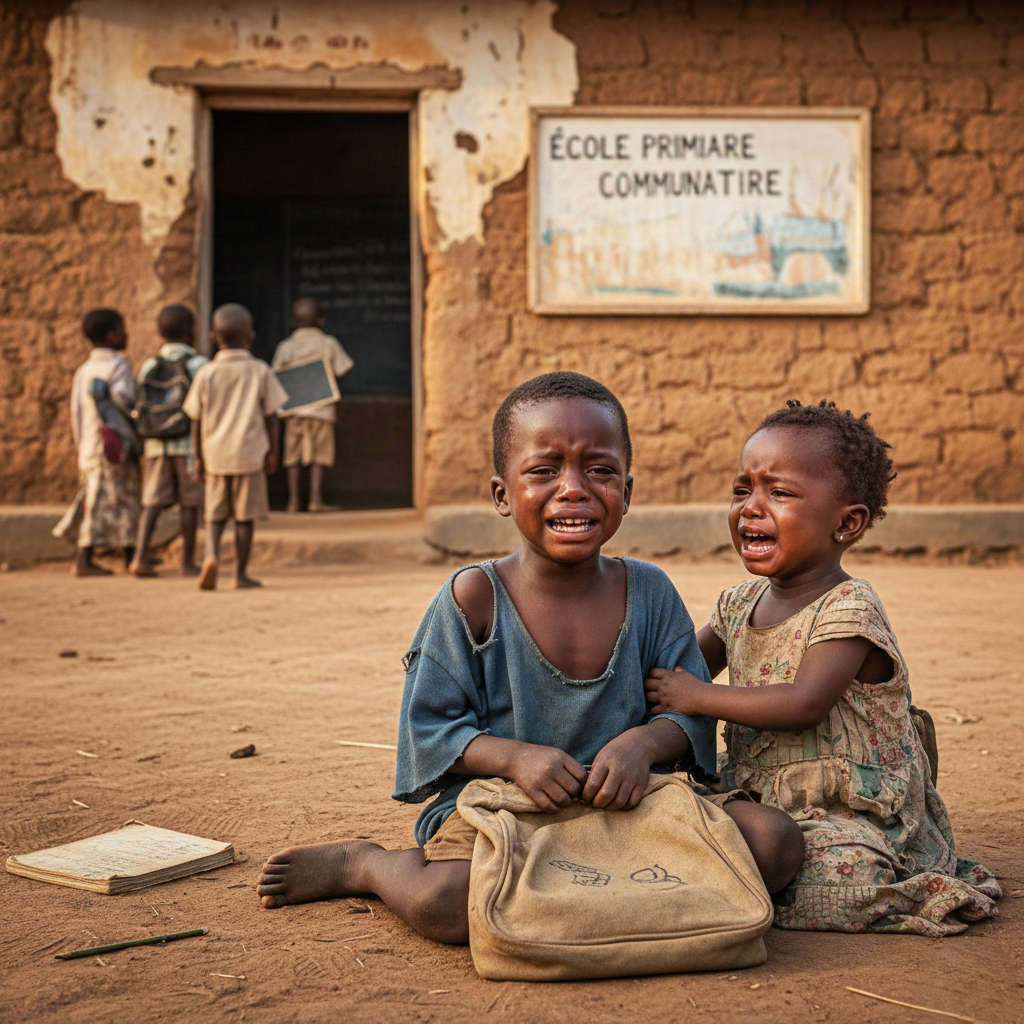
Education is a fundamental right enshrined in the Universal Declaration of Human Rights and the Convention on the Rights of the Child. Yet in contexts marked by armed conflict, it becomes one of the hardest rights to guarantee. In the Democratic Republic of Congo (DRC), the Central African Republic (CAR) and Cameroon, millions of children see their future compromised by persistent insecurity, mass displacement and the destruction of school infrastructure.
In Cameroon, education, a fundamental right guaranteed by the Constitution and international conventions, remains seriously threatened in several regions hit by humanitarian crises. Today, thousands of children in the North-West, South-West and Far North no longer have access to school, direct victims of armed conflict, terrorist attacks and forced displacement.
The teams of SAPI (Save the People International), active in all three countries, see every day the consequences of conflict on children’s schooling and well-being, and witness daily both the obstacles and the resilience of children, families and communities.
1. A fundamental right under threat
1.1. Attacks on schools and widespread insecurity
In conflict zones, schools become targets: military occupation, looting, destruction and threats against teachers. These attacks violate the Safe Schools Declaration, which both the DRC and CAR have signed.
- In the DRC, particularly in North Kivu, South Kivu and Ituri, hundreds of schools close every year. In Masisi, North Kivu, around 2023, armed groups occupied several schools in the Kitchanga and Mweso areas, and in 2024-2025 in the Katoyi area, forcing thousands of children to stay at home. Some classrooms were turned into military bases.
- In CAR, attacks by armed groups lead to prolonged closures, depriving children of an essential protective space. In Ouaka and Haute-Kotto in 2022, schools built by humanitarian NGOs working in the area were looted during clashes, with benches, blackboards and school kits destroyed.
- In Cameroon’s North-West and South-West regions, the socio-political crisis has closed more than 4,000 schools since the start of the Anglophone crisis, according to international organisations. In places such as Kumbo or Mamfe, teachers have been threatened or abducted for trying to keep classes going.
1.2. Mass displacement and interrupted schooling
Armed conflict has caused repeated displacement, as is currently the case in the DRC in areas occupied by M23 rebels and in Ituri province. Internally displaced (IDP) and refugee children often have to drop out of school for lack of suitable education facilities. In the DRC, population movements run into the millions, while in CAR and Cameroon families live in camps or host communities where schools are overcrowded or non-existent.
Conflict forces families to flee, abruptly cutting short children’s schooling.
Examples:
- DRC (Ituri): a 12-year-old girl, displaced from Djugu to Bunia, explains that she has fled three times in two years. Each time, she lost months of school.
- CAR (Bangassou): displaced families live in camps where only informal learning structures are available, often without qualified teachers.
- Cameroon (Far North): Boko Haram attacks drive families towards Mora and Maroua. In some camps, there is only one school for hundreds of refugee and displaced children.
2. Profound consequences for children
2.1. Learning loss and the risk of dropping out for good
After repeated interruptions, many children never return to class.
Examples:
- DRC: in the displacement camps of Nyiragongo, SAPI regularly meets children who have lost two to three years of learning. Some teenagers, too old to return to primary school, drop out for good.
- CAR: long school closures in Ouaka have led hundreds of girls to drop out and marry early.
- Cameroon: in the South-West, some schools have not opened since 2017, creating a “lost generation” of children who have spent their entire adolescence outside the school system.
2.2. Recruitment into armed groups
In the Democratic Republic of Congo, the recruitment of children by armed groups remains an alarming reality, despite years of demobilisation efforts. In North Kivu, Ituri, South Kivu and parts of Maniema, intensified fighting and the lack of functioning schools expose children to a higher risk of forced or voluntary recruitment. Poverty, constant insecurity, the loss of parents, school closures and the lack of prospects push many children to join armed groups in search of protection, food or a sense of belonging. Children out of school are particularly vulnerable.
Since the resurgence of M23 in North Kivu in 2022, the rise of the Wazalendo, popular self-defence groups that mobilise to “protect” their villages against M23 offensives, has created a diffuse and hard-to-control militarisation of young people.
Why are the Wazalendo a challenge for child protection?
- No formal structure: these are non-state groups with no clear hierarchy or disciplinary mechanism. Control over recruitment is virtually non-existent.
- “Voluntary” participation of children: many teenagers join these groups believing they are “defending their community”, in several villages in North Kivu, South Kivu and Ituri in the DRC. This “voluntary” participation is still illegal: any involvement of a minor in an armed group is prohibited, even if the child enlists of their own accord.
- The social normalisation of violence: in some localities, the population sees these groups as “protectors”. Young people are encouraged or praised for joining, yet the groups loot the property of the very people who urged them to join the Wazalendo movement to save the country.
- A total absence of DDR (disarmament, demobilisation and reintegration) mechanisms. Unlike other armed groups, there is no structured programme to demobilise children linked to the Wazalendo. The Disarmament, Demobilisation, Community Recovery and Stabilisation Programme (P-DDRCS) faces a critical funding shortfall, which severely limits its capacity to care for ex-combatants and children who have left armed groups in eastern DRC. Transit centres lack resources for accommodation, food, medical care, psychosocial support and reintegration. Without sustainable funding, several facilities remain closed or only partly operational. This delays demobilisation, increases the risk of re-recruitment and jeopardises the protection of children who need immediate, specialised care.
- Blurred lines with the FARDC (citizen support). Because some Wazalendo operate in support of the loyalist forces (FARDC), the line between the official army and informal self-defence groups has become blurred in several areas, such as Uvira in South Kivu. This makes it harder to identify children associated with armed groups, remove them and refer them to protection programmes. In North Kivu (Rutshuru, Masisi, Nyiragongo), teenagers aged 14 to 17 have joined the Wazalendo to “defend” their villages after M23 attacks.
- In Ituri, in some Hema villages, self-defence groups re-form when the regular forces withdraw. Children take part as informants, porters or scouts. In South Kivu (Fizi, Uvira), displaced young people who have lost access to school are more easily enlisted by local self-defence groups.
2.3. Children associated with armed forces and groups (CAAFAG): a cross-border issue
The phenomenon of children associated with armed groups goes far beyond national borders. It is a regional, cross-border problem affecting the whole Great Lakes region, the Sahel and many areas of protracted conflict. In these contexts of chronic insecurity, collapsing social services, state failure and extreme poverty, thousands of children are recruited, used or exploited by armed actors. Their enlistment is never a real choice: it is the result of violence, lack of protection, being out of school or direct pressure from armed groups.
The roles given to children are many and go far beyond the image of the “child soldier”. Many are used as porters, carrying ammunition, food or heavy equipment over long distances. Others are forced to serve as informants, spies or lookouts, often on the front line of danger. Girls are particularly vulnerable: as well as being used as cooks or domestic helpers, they are frequently subjected to sexual violence, forced “marriages” or sexual slavery. In several recent conflicts, some children have been used as messengers and others, alarmingly, as human shields during fighting.
Even when they do not carry weapons, these children meet the international definition of children associated with armed forces or groups set out by the United Nations. It covers any child associated voluntarily or by force with regular forces or armed groups, whatever their role. This broad approach aims to guarantee stronger protection and prevent any discrimination in disarmament and reintegration programmes.
The cross-border dimension is particularly marked in the Sahel and the Great Lakes, where porous borders and mass displacement make it easier to move children from one area to another. For example, children recruited in the DRC may be moved to other territories controlled by armed groups, while in the Sahel jihadist groups operate simultaneously in Mali, Burkina Faso and Niger, leading to continuous movements of associated children.
This reality calls for regional cooperation, cross-border protection mechanisms and, above all, a firm commitment to strengthen education, child protection and violence prevention systems in all vulnerable communities.
3. Lack of education as a factor in children’s vulnerability to recruitment by armed groups
Education is one of the main child protection mechanisms in situations of armed conflict. When it is absent, interrupted or out of reach, children are exposed to many risks, one of the most serious being forced or voluntary recruitment by armed groups.
Lack of access to school deprives children not only of a place to learn, but also of a secure environment, a protective social network and positive adult guidance. In areas affected by protracted conflict, such as the Democratic Republic of Congo (DRC), the Central African Republic (CAR) and Cameroon’s Far North, this education crisis becomes a decisive factor driving children into armed groups.
In the DRC, the situation is especially alarming in Rutshuru and Masisi territories in North Kivu, Uvira and Fizi territories in South Kivu, and Djugu territory in Ituri province. Repeated school closures, mass displacement and extreme poverty push many children out of the school system. With no guidance and no prospects, several boys report being approached by armed groups promising them food, money, protection or even a valued social status in the community.
When some families struggle to provide even one meal a day, these promises, however false and dangerous, become tempting for teenagers trying to survive. The absence of school thus creates a structural void that armed groups skilfully exploit to attract, manipulate or force children into their ranks.
In the Central African Republic, particularly in Nana-Grébizi prefecture, children out of school become easy targets for armed groups, which often use them as messengers, lookouts, porters or informants. Where schools have been destroyed or closed because of insecurity, children spend their days in the streets or in the fields, which greatly increases their exposure to fighters. Deprived of education and protection, these children are seen by armed groups as resources that are easy to exploit: they move quickly, arouse little suspicion and are more vulnerable to coercion.
In Cameroon’s Far North, Boko Haram strategically exploits the lack of access to school to recruit children from impoverished rural communities. School closures after attacks, insecurity on the roads and the destruction of school buildings have left hundreds of villages with no functioning education system at all.
Boys aged 10 to 15 are particularly targeted: they are enlisted as fighters, spies or carriers, often under direct threats against their families. In some cases, parents themselves, worn down by poverty and the lack of alternatives, give in to threats or manipulation.
In all three countries, the same pattern repeats: the more education collapses, the more child recruitment increases. School therefore plays a fundamental role not only for learning, but also as a protective shield against violence, exploitation and militarisation. Rebuilding infrastructure, keeping children in class, strengthening education-in-emergencies programmes and providing a safe school environment are essential levers to stop children being drawn into armed groups and to break the cycle of violence.