For more than three decades, the Democratic Republic of Congo (DRC) has been going through armed conflicts that deeply affect communities, and children in particular. In the eastern provinces of North Kivu, South Kivu, Ituri and Tanganyika, hundreds of thousands of children have seen their education interrupted, delayed or permanently compromised. Faced with this reality, the NGO SAPI puts education at the heart of its humanitarian work, convinced that access to school is both a fundamental right and an essential means of protection.
Attacks on schools, forced displacement, poverty worsened by war and forced recruitment into armed groups deprive millions of Congolese children of a safe learning environment. Many spend months, sometimes years, without access to structured teaching. For children who are already vulnerable, such as orphans, children separated from their families, street children or survivors of violence, this break in schooling deepens inequalities and increases the risk of exploitation, forced labour, sexual abuse and radicalisation.
In this context, education in emergencies is not a luxury: it is a vital protection mechanism. It gives children stability, hope and a safe space where they can rebuild. That is why SAPI has, for several years and in eastern and central DRC since 2017, been running integrated interventions combining school support, psychosocial care, teacher training, community mobilisation and the creation of safe learning spaces.
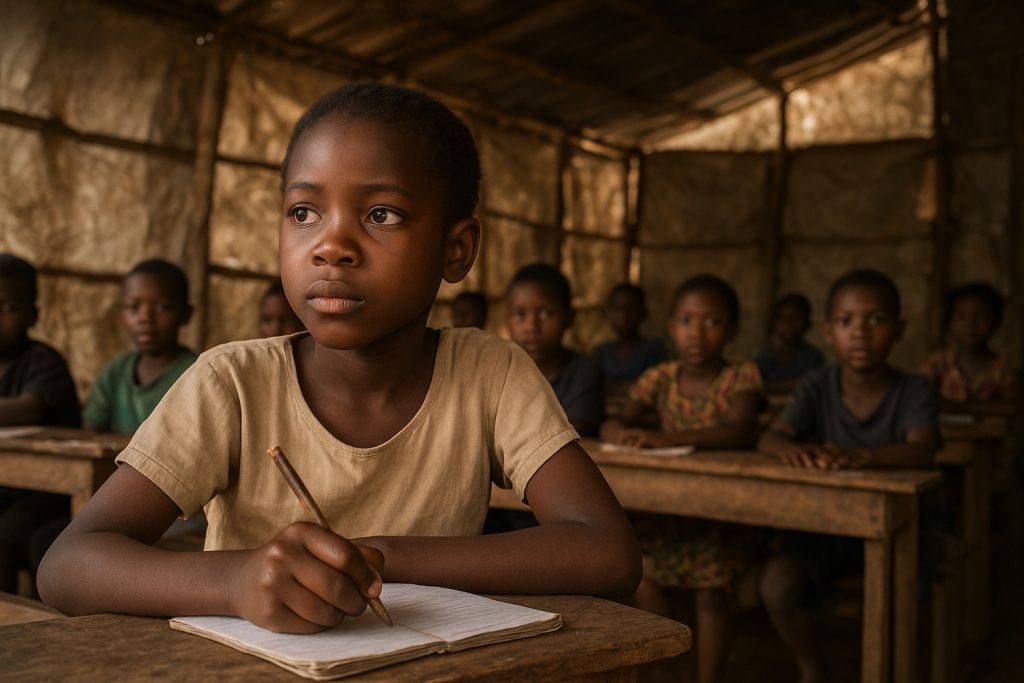
In areas of mass displacement, SAPI sets up Temporary Learning Spaces (TLS) that allow children to keep going to school even in the midst of the crisis. Run by educators trained in emergency teaching methods and psychosocial support, these spaces welcome thousands of children every day. At the same time, SAPI strengthens the capacity of parents’ committees, local schools and education authorities to ensure continuity of schooling as soon as conditions allow.
Another essential part is psychosocial support. Children exposed to violence, displacement or the loss of loved ones need support to regain a minimum of emotional security. Through recreational activities, individual counselling and stress-management sessions, SAPI helps children overcome trauma and return to school with greater peace of mind.
SAPI also supports the school and vocational reintegration of children who have left armed forces and groups, helping them return to normal schooling or access suitable vocational training, depending on their age and situation. This approach supports their social reintegration and reduces the risk of them taking up arms again.
Despite progress, the needs remain immense. SAPI calls for greater commitment from public authorities, international donors and local communities to protect schools, invest in education infrastructure, fund teacher training and guarantee inclusive education for all children, without discrimination.
Education is a lasting answer to the cycle of violence. By supporting children today, the DRC is preparing a generation able to rebuild tomorrow’s peace, stability and development. SAPI remains committed, alongside communities, so that every Congolese child, even in times of war, can learn, dream and build their future.